Introduction
Missing teeth can affect more than the appearance of your smile. They may make chewing less comfortable, change how your remaining teeth meet, and make everyday activities more difficult. Dental implants can be one option for replacing missing teeth and restoring function.
If you are considering dental implants in Clovis, understanding what happens throughout the treatment process can help you prepare for your consultation and know what questions to ask your dentist.
What Are Dental Implants?
A dental implant is a small device placed in the jaw as part of a tooth-replacement treatment. After the implant has time to heal and integrate with the surrounding bone, it can support a replacement tooth or a larger dental restoration.
Unlike traditional removable dentures, implant-supported restorations receive support from implants placed in the jaw.
The treatment plan depends on several factors, including the number of missing teeth, the condition of your remaining teeth, your gums and jawbone, your overall oral health, and your treatment goals.
Step 1: Start With a Dental Implant Consultation
The process typically begins with an evaluation of your current dental condition.
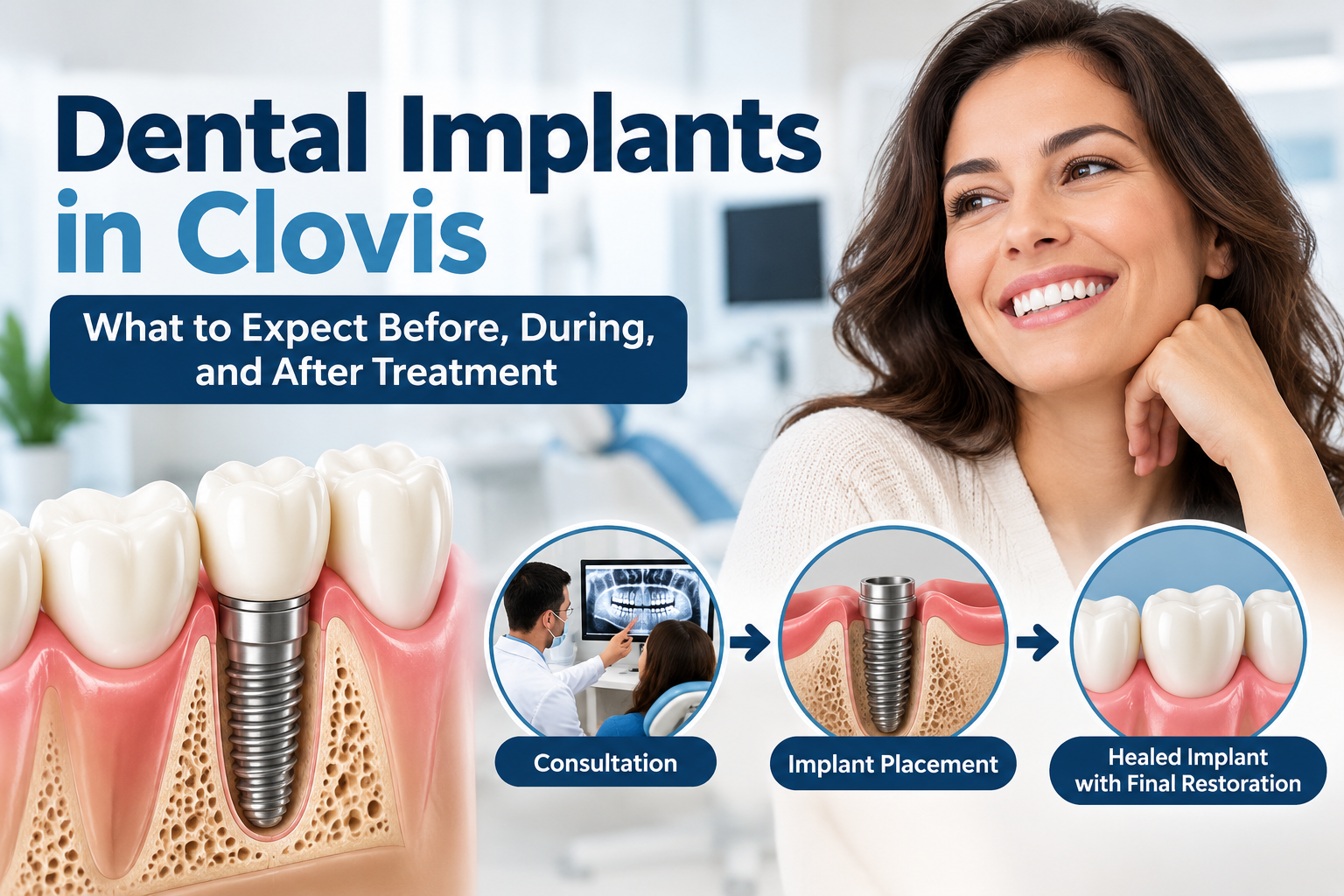
During the consultation, your dentist may examine your teeth and gums and use dental imaging when needed to evaluate the proposed implant sites. You may discuss which teeth need to be replaced, whether existing teeth can be preserved, the condition of your gums and jawbone, possible treatment options, treatment stages, healing and recovery, estimated costs, and alternatives to dental implants.
A consultation also gives you an opportunity to ask questions and understand why a particular treatment plan may be recommended.
Step 2: Evaluate Your Teeth, Gums, and Jawbone
Not every patient has the same implant needs. Your dentist will consider the condition of the area where an implant may be placed.
The number and location of missing teeth can influence the type of restoration being considered. Your remaining teeth also need to be evaluated because healthy teeth may be worth preserving, while severely damaged teeth may require a different treatment strategy.
Your gums and available jawbone are also important parts of treatment planning. If additional treatment is needed before an implant can be placed, your dentist can explain the recommended steps.
The goal is to develop a treatment plan that fits your dental condition.
Step 3: Prepare for Implant Treatment
Once your treatment plan has been established, your dentist can explain what needs to happen before implant placement.
Preparation varies from patient to patient. Some people may be ready to move forward with implant placement, while others may need additional dental treatment first.
Your dentist can discuss the sequence of treatment based on your teeth, gums, bone condition, and overall oral health.
Step 4: Dental Implant Placement
During implant treatment, the implant is placed in the jaw as part of the tooth-replacement process.
The implant provides a foundation for the future restoration. After placement, the implant needs time to heal and become stable within the surrounding bone.
The exact treatment process can vary depending on the patient’s condition and the type of restoration being planned.
Step 5: Allow Time for Healing
Healing is an important part of dental implant treatment.
After the implant is placed, it needs time to integrate with the surrounding bone. This process provides the stability needed for the implant to support the planned restoration.
The length and progression of healing can vary depending on the individual treatment plan and the patient’s dental condition.
Step 6: Receive the Final Restoration
Once the implant has healed and is considered stable, it can be used to support the planned restoration.
For an individual missing tooth, an implant may support an abutment and dental crown. When a patient has more extensive tooth loss, implants may support a larger restoration.
The type of restoration depends on the number and pattern of missing teeth, the condition of the remaining teeth, and the overall treatment plan.
What Is Recovery Like?
Recovery is different for every patient and depends on the treatment performed.
Your dentist can explain what to expect during healing and provide instructions for caring for the treatment area. You may also discuss eating, oral hygiene, follow-up appointments, and returning to your normal routine.
Because implant treatment involves multiple stages, it is important to follow the recommended schedule and attend follow-up visits.
How Should You Care for Dental Implants?
Dental implants still require regular oral hygiene and professional dental care.
Daily brushing, appropriate cleaning around the implant and restoration, and regular dental checkups can help maintain your oral health.
Factors such as poor oral hygiene, gum disease, smoking, and excessive forces on the restoration can create additional concerns.
How Long Can Dental Implants Last?
Dental implants are intended to provide a long-term replacement for missing teeth, but their performance over time depends on several factors.
Maintaining healthy gums, practicing good oral hygiene, attending regular dental check-ups, and caring for the restoration can all contribute to maintaining the treatment.
Are Dental Implants Right for Everyone?
Dental implants can be an option for many patients, but they are not automatically the right choice in every situation.
Your dentist will consider your oral health, jawbone, gums, remaining teeth, number and location of missing teeth, overall dental condition, and treatment goals.
If another treatment or procedure is needed first, your dentist can explain why and discuss the available options.
What Should You Ask During Your Implant Consultation?
A dental implant consultation is a good time to get clear answers before making a treatment decision.
Consider asking which teeth should be replaced, whether existing teeth can be preserved, whether your jawbone is suitable, whether your gums are healthy enough, what treatment stages you will need, how long the process may take, what to expect during healing, what type of restoration will support the implant, what the treatment may cost, and whether alternatives are available.
Dental Implants in Clovis: Understanding Your Treatment Options
Dental implant treatment involves more than simply placing an implant. It includes evaluating your oral health, planning the treatment, placing the implant, allowing time for healing, and completing the final restoration.
Whether you are replacing one missing tooth or dealing with more extensive tooth loss, your treatment plan should be based on your individual dental condition and goals.
If you are considering dental implants in Clovis, Clovis Family Dentistry can evaluate your needs and discuss the tooth-replacement options that may be appropriate for you.
Learn more about dental implant treatment at Clovis Family Dentistry: https://clovisfamilydentistry.com/